Explore our flagship series of digital label rewinders, automatic counters, and precision slitting converting equipment engineered for global converting operations.
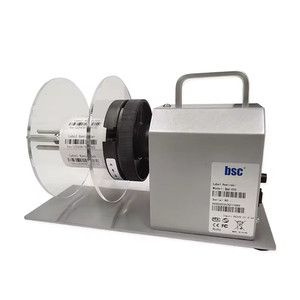
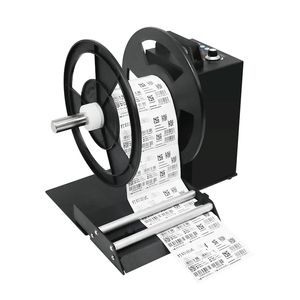
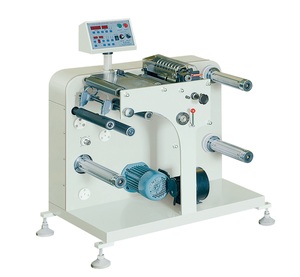
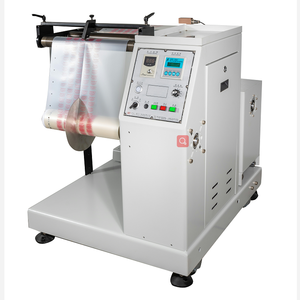
In the modern label printing and flexible packaging ecosystem, the manufacturing performance of post-press roll converting systems directly influences production yield, web tension fidelity, and overall operational efficiency. As digital printing presses reach unprecedented speed metrics and substrate versatility expands to ultrathin PET films, thermal papers, and eco-friendly mono-materials, industrial label rewinders have evolved from simple passive collection mechanisms into highly engineered, closed-loop servo-driven control hubs.
As a leading Chinese manufacturer and global exporter of label rewinding machinery, our engineering philosophy bridges high-speed roll processing with sub-millimeter web guidance and dynamic tension optimization. Whether integrating inline with industrial inkjet presses or performing offline roll inspection, counting, and slitting, precise mechanical synchronization prevents web telescopy, edge wrinkling, matrix breaking, and static build-up.
Real-time feedback via load cell sensors and dynamic dancer arms ensures instantaneous motor torque adjustment down to ±0.05 N·m across variable roll diameters.
Integrated high-definition CMOS photoelectric sensors and strobe visual systems verify barcode readability, label count accuracy, and surface defect flags at high speeds.
Standard 3-inch (76mm) and customizable 1-inch to 6-inch quick-change pneumatic air shafts guarantee zero core slippage and swift roll loading workflows.
To fully appreciate the information gain associated with advanced Chinese manufacturing, one must analyze the mechanical and electrical subsystems that distinguish basic table-top rewinders from heavy-duty industrial slitter-rewinders. A precision label rewinder must overcome three primary physical phenomena during operation: taper tension degradation, web drift, and inertia mismatch during acceleration/deceleration cycles.
When a label roll rewinds, its diameter continuously increases. If motor torque remains static, the linear tension on the label web decreases proportionally ($T = \frac{\tau}{r}$). This results in loose outer layers and crushed inner cores—a structural defect known in the converting industry as "telescoping" or "starring."
Our machine series, including the Tension Control Motor Rewinding Tool Roll Label Slitter Rewinder Machine, utilizes micro-processor-controlled dynamic taper tensioning algorithms. By measuring instantaneous diameter via non-contact ultrasonic sensors or encoder pulse feedback, the system adjusts vector servo drive torque automatically, applying a taper curve (typically between 0% and 50%) to lock inner layers securely while preserving sensitive surface embellishments and liner release properties.
| Performance Specification | Standard Series (Compact) | Industrial Heavy-Duty Series | High-Speed Digital Integration Series |
|---|---|---|---|
| Max Web Width Range | 120 mm - 230 mm | 330 mm - 650 mm | 210 mm - 450 mm |
| Maximum Rewind Diameter | 300 mm (11.8 in) | 700 mm (27.5 in) | 500 mm (19.6 in) |
| Max Line Speed Capacity | Up to 60 m/min | Up to 300 m/min | Up to 150 m/min (Synchronized) |
| Tension Control Precision | Magnetic Brake ± 0.2 N | Dual Servo Closed-Loop ± 0.05 N | Vector Servo Feedback ± 0.08 N |
| Counting Module Accuracy | Optical IR (99.8%) | CCD Vision + Tachometer (100%) | Fiber Optic Dual Sensor (99.99%) |
| Air Shaft Standard Core | 1.5 in / 3 in Pneumatic | 3 in / 6 in Quick-Lock Pneumatic | 3 in Differential Shaft Optional |
High-speed rewinding without active web guidance inevitably leads to staggered roll edges, causing damage during downstream processing on automated application lines. Modern Chinese converting equipment integrates ultrasonic or optical web guide systems featuring electromechanical actuator drives. These systems constantly track the material edge or printed benchmark line, dynamically correcting lateral web offset within a tight tolerance of $\pm 0.1 \text{ mm}$.
For converters seeking multi-lane separation, combining rewinding with rotary shear, razor, or crush slitting offers massive efficiency gains. Machines like our High Speed Small Slitting Rewinding Machine for Labels and Film Roll to Roll Converting allow operators to convert jumbo rolls into precise narrow ribbons, complete with edge trim removal via pneumatic venturi suction tubes.
Over the past decade, the global procurement landscape for print finishing machinery has undergone a structural pivot. B2B buyers across North America, Europe, Latin America, and Southeast Asia are shifting away from high-cost legacy regional producers toward specialized Chinese original equipment manufacturers (OEMs). This trend is driven by several macro factors:
Chinese engineering delivers premium componentry—including Schneider electronics, Yaskawa servos, and Sick sensors—at capital expenditures 40% to 60% lower than Western counterparts.
Modular machine architectures allow seamless customization—such as combining barcode label counting with inkjet printhead mounting slots or thermal ribbon rewind adapters.
Standardized spare parts availability, multilingual HMI screens (English, German, Spanish), and cloud-connected remote diagnosis ensure 24/7 continuous operation.
As the label converting industry moves toward Industry 4.0 digital integration, post-press finishing equipment must adapt to new operational realities. Procurement officers and plant managers should consider several emerging technological vectors when evaluating label rewinder purchases:
Modern end-users in pharmaceuticals, electronics, and food packaging demand zero-defect label roll delivery. Rewinders are increasingly equipped with 100% optical inspection systems capable of detecting missing labels, color shifts, registration errors, and matrix residue at speeds exceeding 200 m/min. When a defect is flagged, the rewinder automatically decelerates and stops with the defective label precisely positioned on an inspection table for operator remediation.
Next-generation label rewinders, such as our Full Automatic Roll Barcode Sticker Label Rewinding Machine With Counter, feature native Modbus/TCP and Ethernet/IP protocols. Machine telemetry—including linear meters run, roll count, operating speed, downtime cause analysis, and power consumption—is transmitted directly to enterprise ERP/MES platforms to calculate real-time Overall Equipment Effectiveness (OEE).
With global regulations pushing toward thinner liner materials (e.g., 23-micron PET liners) and bio-based film substrates, controlling static electricity generated by friction during high-speed rewinding is vital. Modern machinery integrates active ionizing bar arrays across the unwind, slitting, and rewind zones to neutralize static charges up to 30 kV, preventing operator shock hazards and dust accumulation.
Drawing on decades of industrial engineering experience (similar to world-class equipment lineages such as Spartanics converting platforms), every label rewinder engineered in our facility undergoes rigorous pre-shipment validation. Before your machine leaves our floor, your specific label substrate is test-run to verify speed tolerances, optical counter accuracy, and edge alignment.
Below are detailed answers to technical and commercial questions frequently raised by overseas buyers when sourcing label rewinding and slitting equipment from China.
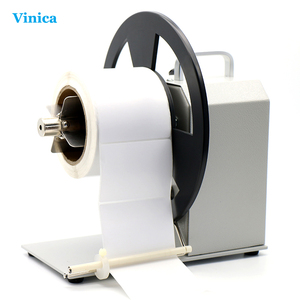
Table-top label rewinders are compact, passive units designed primarily to collect printed labels directly from desktop thermal transfer or inkjet label printers at low speeds (up to 15-20 m/min). They generally utilize basic mechanical slip clutches for tension control.
In contrast, industrial roll rewinders (such as our Label Rewinder Roll to Roll Large Diameter and Capacity Series) feature independent heavy-duty steel frames, dynamic vector servo drives, dynamic dancer tension feedback, pneumatic expanding air shafts, and precise web guidance. They handle roll diameters up to 700 mm at line speeds up to 300 m/min and can integrate slitting, counting, and vision inspection modules.
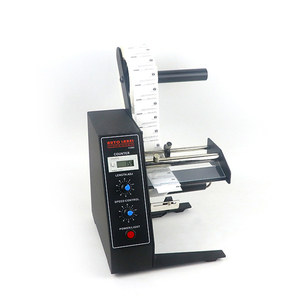
Our counting rewinders (such as the High-Quality J150 Reel to Reel Label Counter Rewinding Machine) utilize advanced dual photoelectric infrared sensors or optical fiber sensors. The sensor detects the gap between pressure-sensitive labels on the release liner. For clear-on-clear (transparent PET) labels, specialized ultrasonic gap sensors or contrast optical sensors are deployed. The digital controller tracks batch quantities, total piece counts, and linear meters simultaneously, triggering an automatic soft-stop once the preset quantity is reached.
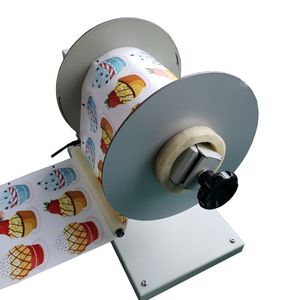
Yes. Customization models like the Vorey R230 Customization Sticker Rewinder Unwinder are specifically designed to synchronize with commercial digital printing engines (e.g., TrojanOne, Epson, Memjet, or Xeikon systems). Equipped with dynamic dancer arm buffer assemblies and optical speed match sensors, the unwinder/rewinder dynamically adjusts rotational speed to match the print engine's start-stop cycles without subjecting the web to sudden tension spikes.
The global industry standard for label roll inner cores is 3 inches (76 mm). However, our machinery can be customized with interchangeable air shafts or mechanical core adapters ranging from 1 inch (25.4 mm), 1.5 inch (38 mm), 40 mm, to 6 inches (152 mm) to match your specific production requirements.
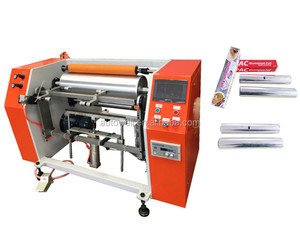
Specialty substrates—such as aluminum foil or flexible cling film handled by our Aluminium Foil Cling Film Roll Rewinder Machine—exhibit distinct elastic deformation characteristics under tension. These materials require ultra-sensitive closed-loop tension regulation. We utilize magnetic powder brakes or multi-servo tension vectoring coupled with ultra-low friction pneumatic cylinders on dancer rollers to maintain gentle, consistent tension, preventing material stretching, necking, or tear-outs during high-speed winding.
All exported machinery can be built to comply with local electrical requirements (e.g., 220V 1-Phase, 380V 3-Phase, or 480V 3-Phase at 50Hz/60Hz). Machines are equipped with emergency stop circuits, protective safety interlocks, CE-marked low-voltage electronics, and optional safety light curtains.
Navigating the requirements of modern label finishing demands equipment that combines mechanical robustness with intelligent digital control. As an established OEM manufacturer and global exporter, we provide full technical support—from custom machine design and CAD layout drawings to material test validation and overseas engineer deployment.
Optimize your roll converting floor with machinery engineered for maximum uptime, millimeter-accurate web registration, and rapid return on investment. Contact our engineering support team today to request custom technical drawings, substrate testing videos, and complete factory-direct pricing catalogs.
