Explore our flagship series of automated silk screen printing, web-fed digital converting, and specialized laser finishing machinery. Engineered to meet strict industrial tolerances across global manufacturing plants.
In high-throughput manufacturing, selecting the optimal die cutting technology directly dictates unit economics, yield rates, and operational flexibility. Modern industrial converting has evolved beyond traditional mechanical mechanical stamping presses to encompass advanced digital laser die cutting systems, roll-to-roll web handling, and high-speed optical registration platforms. As global demand accelerates for short-run customization, variable graphics, and complex substrate processing, equipment buyers must evaluate the underlying engineering physics behind each converting method.
Traditional rotary die cutting relies on physical steel cylinder dies to shear substrates against an anvil roller. While rotary tooling offers high linear web speeds on fixed-shape runs exceeding 500,000 units, it introduces significant setup friction: substantial die procurement costs, 2-to-4 week lead times, physical die wear, and mechanical alignment delays. Conversely, digital laser die cutting utilizes high-frequency CO2 or fiber galvanometric laser optical heads to vaporize or melt substrate boundaries without physical contact.
By eliminating physical dies, laser finishing platforms achieve spot sizes down to 0.004 inches (0.1 mm). This laser focus enables micro-perforations, zero-radius internal corner contours, and immediate job changeovers driven directly by vector CAD files. Furthermore, advanced laser software automatically dynamically adjusts laser power output proportional to web velocity, guaranteeing zero burn marks or substrate discoloration even during speed ramp-up and ramp-down cycles.
Zero physical tooling required. Eliminate die storage, resharpening overhead, and plate lead times. Process versioned SKUs on-demand directly from digital print files.
High-resolution CCD cameras scan registration marks in real-time. Software dynamically adjusts cut-paths to compensate for web stretching, skew, and thermal shrinkage.
Precise depth modulation allows selective laser cutting through pressure-sensitive face stock while leaving the silicone-coated release liner completely intact.
Material behavior under die cutting varies depending on thermal conductivity, tensile strength, adhesive viscosity, and optical reflectivity. Below is a validated engineering reference matrix for industrial substrate converting:
| Substrate Material | Recommended Converting Technology | Typical Applications | Key Process Advantage |
|---|---|---|---|
| BOPP & Pressure-Sensitive PET | Galvanometric Laser / Digital Converting | Prime Labels, Cosmetic Packaging | Edge-sealed cuts without adhesive bleed or matrix tearing |
| Polycarbonate & Polyester (100–500 µm) | Mechanical Die Press / High-Power Laser | Membrane Switch Overlays, Control Panels | Burr-free edge finish with micro-registration for window cutouts |
| PVC & ABS Rigid Sheets | Heavy-Duty Hydraulic / Mechanical Punch | Financial Cards, Government ID, Security Cards | Ultra-clean hydraulic stroke alignment preventing layer delamination |
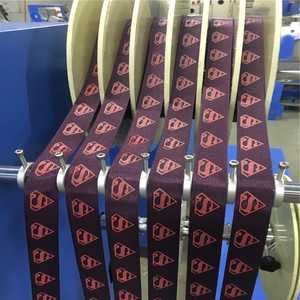
| Woven Nylon & Satin Webbing | Continuous Roll-to-Roll Screen + Thermal Cut | Apparel Labels, Industrial Webbing Straps | Simultaneous multi-color ink deposition with sealed anti-fray edges |
| Flexible Printed Circuits (FPC) | High-Precision Optical Registration Screen/Laser | Medical Sensors, Automotive Dash Electronics | Conductive silver ink deposition with micro-inch trace integrity |
As converting plants modernize to handle smaller lot sizes and faster turnaround times, executive procurement teams must align their capital expenditure (CapEx) with macro technological shifts. Key developments shaping the next decade of die cutting and screen printing equipment include:
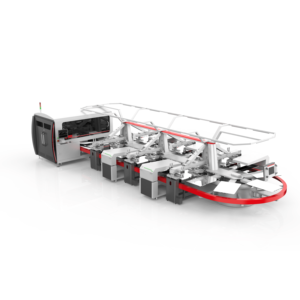
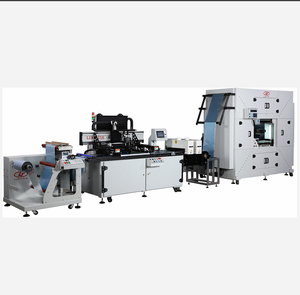
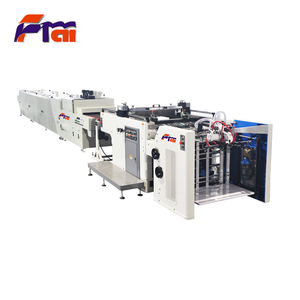
Stand-alone converting units are being rapidly replaced by single-pass inline platforms. Modern architectures seamlessly combine single-pass digital inkjet printing, multi-color UV screen printing, rotary hot stamping, lamination, and laser die cutting on a single servo-driven web chassis. This eliminates manual roll transfers between machines, reducing material waste by up to 18% per production batch.
High-resolution line-scan vision sensors now operate in closed-loop synchronization with laser scanning heads and servo web feeders. By capturing real-time print distortion, skew, and thermal shrinkage on flexible webs, AI algorithms dynamically adjust vector cutting matrices on a frame-by-frame basis—maintaining registration tolerances within ±0.05 mm at line speeds exceeding 100 m/min.
Next-generation converting machines feature embedded sensor arrays tracking laser tube efficiency, servo motor thermal signatures, pneumatic pressure consistency, and bearing friction profiles. Industry 4.0 telemetry allows machine manufacturers to conduct remote diagnostics, push firmware updates, and dispatch preventive service prior to component failure.
With global sustainability mandates tightening around packaging waste, automated laser die cutting enables complex matrix-stripping paths previously impossible with physical dies. Intelligent waste-winders, combined with precise depth laser kiss-cutting, allow converters to run thinner liner papers (down to 23-micron PET liners), dramatically lowering shipping weight and carbon footprint.
Rooted in over 60 years of North American precision engineering and global manufacturing deployments across more than 60 countries, our facility in Rolling Meadows, Illinois, alongside specialized international manufacturing partnerships, continues to pioneer advancements in cutting, counting, and printing technologies.
We do not quote on promises—we quote on empirical material tests. Before any equipment leaves our factory floor, your specific substrates undergo live sample testing on our demonstration lines. We provide comprehensive cut quality metrics, edge analysis, and verified production speeds.
Our machine frames are heavy-gauge stress-relieved steel fabrications engineered to eliminate vibration harmonic distortion during high-acceleration stroke cycles. Micro-servo drives deliver micron-level registration accuracy across decades of continuous 24/7 industrial operation.
With machines deployed globally, our customer infrastructure includes factory-certified field service engineers, rapid-dispatch spare parts programs, and remote IP-connected technical diagnostics to guarantee maximum machine uptime anywhere in the world.
Empowering plant managers, procurement directors, and manufacturing engineers with actionable technical insights.
Laser die cutting reaches economic superiority under three specific operational scenarios: (1) Short-to-medium production runs (under 100,000 units) where physical die costs ($500–$3,000 per shape) erode profit margins; (2) Highly complex shapes containing intricate internal cutouts, micro-perforations, or sharp internal radii that cause physical blades to fail; and (3) Dynamic SKU environments requiring frequent design modifications. With zero die spend and near-instant digital setup, laser converting delivers immediate ROI on short-run digital print work.
When cutting synthetic films such as PET, BOPP, Polycarbonate, and PVC, our laser optics deliver a micro-sealed edge finish. The laser beam’s concentrated thermal energy melts the material edge in microseconds, creating a smooth, rounded edge profile that prevents film slivering and edge tearing during high-speed matrix stripping. Beam parameters (pulse frequency, power, and galvo velocity) are fine-tuned to prevent discoloration or heat-affected zones (HAZ).
Our vision-guided software continuously captures registration marks or printed image edges using high-speed camera sensors mounted upstream of the cutting zone. If thermal tension or moisture exposure causes web distortion, the digital system automatically calculates X-Y translation, rotational skew, and scaling factors. It instantly remaps the vector laser cut-path in real time to match the distorted print, achieving sub-millimeter accuracy (±0.05 mm).
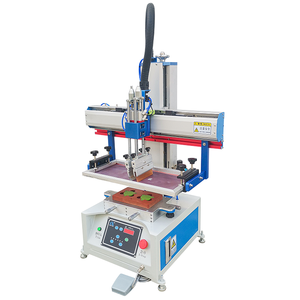
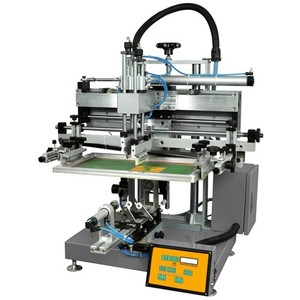
Yes. Our precision silk screen printing machinery (such as the pneumatic and flatbed series) is engineered specifically for heavy ink film deposits and precise film thickness uniformity. This is critical for functional conductive silver, carbon, and dielectric inks used in membrane keypads, biosensors, RFID antennas, and flexible printed circuits (FPC), ensuring stable electrical conductivity across entire production batches.
Our optical card counting platforms (such as the Spartanics 680 series) utilize high-resolution optical scanning technology to count and verify up to 500 plastic, credit, or ID cards in approximately 5 seconds. The contactless optical counting method eliminates card edge damage, scratching, or static build-up, providing 100% audit accuracy for high-security payment and government ID manufacturing facilities.
Send our engineering team your material samples, CAD drawings, and volume targets. We will run custom diagnostic tests on our facility floor and provide a comprehensive technical assessment report.
